Craig Reucassel on Reuse and the War on Waste
An interview with Craig Reucassel, presenter of the ABC series War on Waste
This article is part of Circular Sydney, ReCo’s initiative to empower sustainable businesses, supported by the City of Sydney Knowledge Exchange grant. See how it came to life in our case study.

, ABC War On Waste
Written by
, Zoe Duc
, Danling Xiao
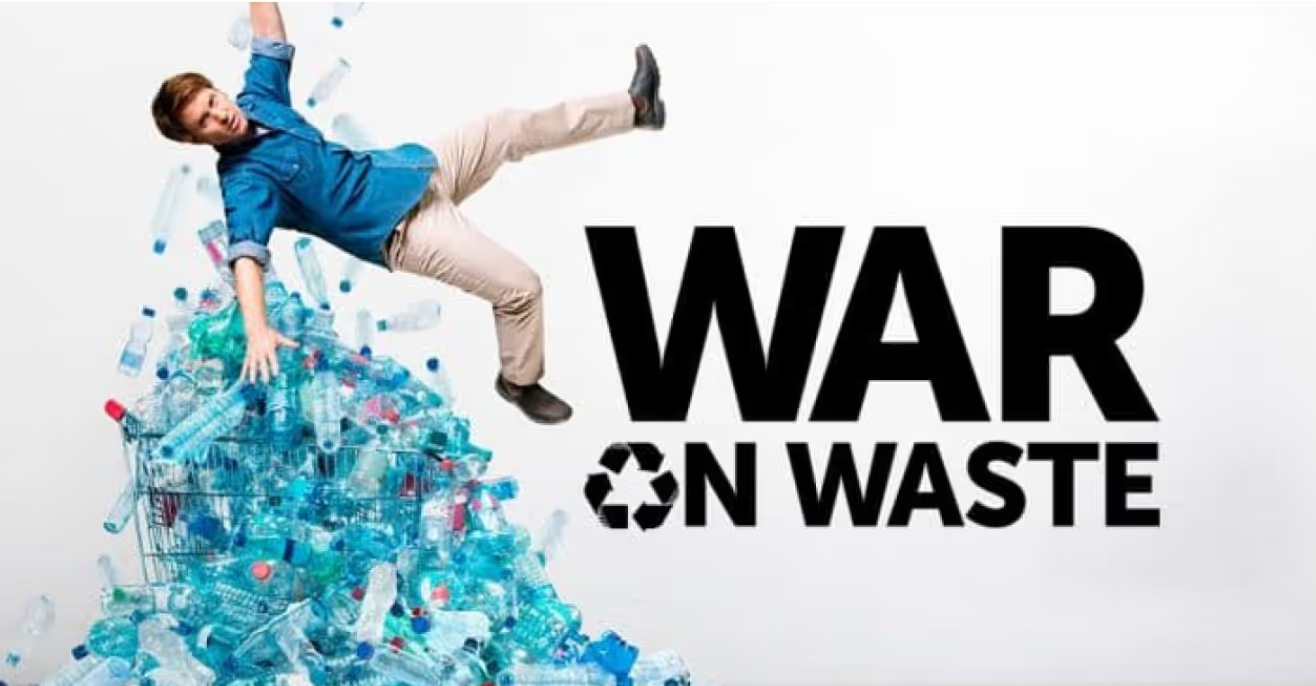
Image: ABC War On Waste
Summary
Reuse extends a product’s life and is the simplest way to cut its footprint, yet recycling gets the attention. Craig Reucassel, presenter of the ABC’s War on Waste, explains why convenience remains the biggest barrier, what the 15-cent bag charge revealed about how habits really shift, and why a television programme only changes anything if communities act on it.
What this interview covers
Why is reuse important? how does it contribute to a circular economy?
What are the barriers to adopting reuse?
How can we motivate individuals and communities to prioritise reuse over single-use products?
How do you see the roles of programs like war on waste contribute to the circular economy?
How has the government responded to war on waste? since then we’ve seen states banning single-use plastics.
How can we work together to drive change towards reuse?
What are your favourite reuse initiatives?
Where can we watch the latest war on waste?
As Craig returns for the War on Waste 3, we discussed the importance of reuse and how we can collectively drive meaningful change towards a more sustainable future.
Extending a product’s life is the simplest way to reduce your footprint.
Craig Reucassel, ABC War on Waste
Why is reuse important? How does it contribute to a circular economy?
The circular economy is about how we take resources and keep them going. Reuse is part of it, but it goes even further. Reuse is about extending the life of a product.
Extending a product’s life is the simplest way to reduce your footprint. For example, if you can use your reusable bottle for an extra year, you’ve substantially reduced the impact of it.
Reuse also saves water, natural resources and the carbon footprint associated with recycling. In Australia, recycling is improving, but more is needed. There are still many things that end up in landfill.
Anytime you can reuse, it’s a better approach. While we need to recycle better, reuse should be put back on top of the system.
What are the barriers to adopting reuse?
Convenience is a massive barrier to reuse. We’re all very used to things being made ready and delivered to us. We often can’t take our own containers to get a refill from the shops, but that’s about changing our habits, which is very difficult.
There can be competing interests between being sustainable and being convenient. For example, we’re seeing supermarkets trying to cater for both demands. They’re phasing out plastic bags. But at the same time, they’re also packaging up pre-cut vegetables in plastic, making it quick and convenient for customers.
There’s very little punishment for single-use items and no incentives to reuse. The government doesn’t set up proper laws or mandates. Prices vary from one state to another in Australia. For example, even though we have landfill levies, it’s often still cheaper to send things to landfills than to recycle them. Companies can reuse and recycle, but they don’t get incentives, and they have to compete with those who throw things out for a much cheaper cost. Without broader regulations and incentives, businesses are going to continue catering for those who want convenience and following the lowest cost option.
There are successful examples like CHEP’s reusable shipping pallets, which circulate around the world. But, figuring out a reuse system in society is still challenging. What we can do, on a personal level, is to change our own habits, even simple ones like bringing our own coffee cups.
How can we motivate individuals and communities to prioritise reuse over single-use products?
We’ve seen a lot more people become more eco-conscious. For those who care, we need to keep encouraging them by highlighting how much can be saved and how much better it is for the environment.
Changes within communities will create positive influence and social pressure. For example, reusable coffee cups sales have surged after we launched War on Waste in 2017. But the change didn’t happen just because of the show. We saw a slow social pressure being built by early adopters. People started to notice others bringing their reusable cups and wanted to do the same.
People care, but they may not be aware of their impact or alternatives. In the example of takeaway coffee cups, some people are unaware that there’s a plastic lining in the cups that makes them difficult to recycle. We need to show people what needs to be changed and how to do it.
For people reluctant to change, creating incentives and making single-use more expensive is an effective way. When supermarkets implemented the 15-cent charge on plastic bags, Woolworth’s studies found that over 80% of people would bring their own bags. A large portion of these people do it because of the 15 cents, not for environmental reasons. They used to forget to bring their own bags, but now they remember because there is a financial reason to. So, you’ve just got to use incentives to reward those new behaviours.
Slow social change can lead to bigger change. Motivating people to make the right choices is about collectively embracing all the small steps. It creates a positive ripple effect. By showing how these small actions add up, we can inspire more people to join in.
How do you see the roles of programs like War on Waste contribute to the circular economy?
War on Waste is here to highlight the problems and the potential solutions. We spend lots of time researching, figuring out what’s the real problem that we’re trying to solve. We then spend a lot of time coming up with creative ways to tell the story. I have people coming up to me telling me their workplaces have finally made a change after watching War on Waste.
Creativity is a powerful tool. Telling the story differently can sometimes make change happen. But I’ll be honest with you, occasionally we have ideas we think are great, but then we can’t even figure out ways to film them, it gets expensive or we can’t find a compelling way to say it.
However, the real change comes from the community and its response. So, a show like War on Waste only achieves change if people get behind it and take action in their community.
How has the government responded to War on Waste? Since then we’ve seen states banning single-use plastics.
The single-use plastic ban is a step in the right direction, but significant progress still needs to be made. The government needs to invest a lot more in infrastructure to increase reuse and recycling. Banning single-use plastics only solves one part of the problems; we still have an enormous plastic footprint, and we don’t have a lot of solutions at the moment.
I found that the government often responds much later and slower than the community when it comes to change. We’ve seen lots of really great changes happening a lot quicker amongst people, which then influence their local councils and businesses. The government responds when it sees momentum in the community.
So, change must happen within the community. If we see a million people in the community making a change with a social pressure effect, then it has a political pressure effect. It’s really positive.
How can we work together to drive change towards reuse?
All parts need to work together:
The government needs to implement regulations and incentives.
Businesses need to make it easy and rewarding to reuse.
Individuals need to change their habits.
First, we need to make it easy to reuse. Take the example of reusable water bottles. Now people carry reusable water bottles, it’s great, but you still need to build refill water stations. You can’t find any in most shopping centres. That’s where we need government regulations. Every floor of shopping centres should be equipped with a refill station so that people can easily refill their water bottles.
Businesses and innovation play a valuable role in this transition. There are already businesses working on better solutions. But you need to recognise that you’re constantly battling against that convenience. So, try to develop ideas to make your solution as easy as possible. You also need to incentivise and reward people more. Show them the positive impact of their behaviour.
For individuals, it’s important that we keep up the momentum because, eventually, we’ll create a ripple impact when enough people join the journey.
What are your favourite reuse initiatives?
I love my reusable coffee cup. It’s celebrating its seventh anniversary. I drink a lot of coffee, so there have been thousands of takeaway paper cups saved.
Op shops and clothes swaps are also great examples of reuse in the fashion industry. Fashion has an enormous environmental footprint. Op shops and clothes swaps not only minimise waste but also support social programs.
Moreover, we’re seeing a rise in reuse in Australia with Facebook Marketplace and Gumtree. Nowadays, it’s easy to furnish a whole house with free things. This swapping community gives hope for the future of reuse.
Where can we watch the latest War on Waste?
War On Waste 3 is now aired on ABC TV and iView. Watch trailer below:
Frequently asked questions
Why is reuse better than recycling?
Reuse extends the life of a product, which saves the water, natural resources and carbon that recycling itself consumes. Reucassel argues it belongs back at the top of the system.
What stops people reusing more?
Convenience. Habits are hard to change, there is little penalty for single-use items and few incentives to reuse, and in many cases landfill is still cheaper for business than recycling.
Do financial incentives actually change behaviour?
Yes. After supermarkets introduced a 15-cent charge on plastic bags, Woolworths found more than 80% of people brought their own, many for the charge rather than for environmental reasons.
Did War on Waste change anything?
Reusable coffee cup sales surged after the programme launched in 2017, though Reucassel credits slow social pressure from early adopters as much as the show itself.
Why are takeaway coffee cups hard to recycle?
Most contain a plastic lining, which many people are unaware of, making them difficult to process through standard recycling.
What role should government play?
Reucassel points to the absence of consistent laws and mandates, prices that vary between states, and the lack of incentives for companies that reuse while competitors dispose of material more cheaply.
Relevant links
Written by
Zoe Duc
Editor
Zoe Duc is a passionate environmental writer, graduated from a master’s degree of journalism and communication at UNSW.
Danling Xiao
Editor
Danling Xiao is an award-winning entrepreneur and Strategic Director at ReCo. With over a decade of experience spanning brand strategy, customer insight and content marketing, she helps founders and leadership teams navigate complex, highly regulated markets to make confident, high-stakes decisions.