Piers Grove on Funding Circular Economy Startups
An interview with Piers Grove, Co-founder of Boomerang Labs
This article is part of Circular Sydney, ReCo’s initiative to empower sustainable businesses, supported by the City of Sydney Knowledge Exchange grant. See how it came to life in our case study.

, Boomerang Labs
Written by
, Pak Chuen Lee
, Danling Xiao
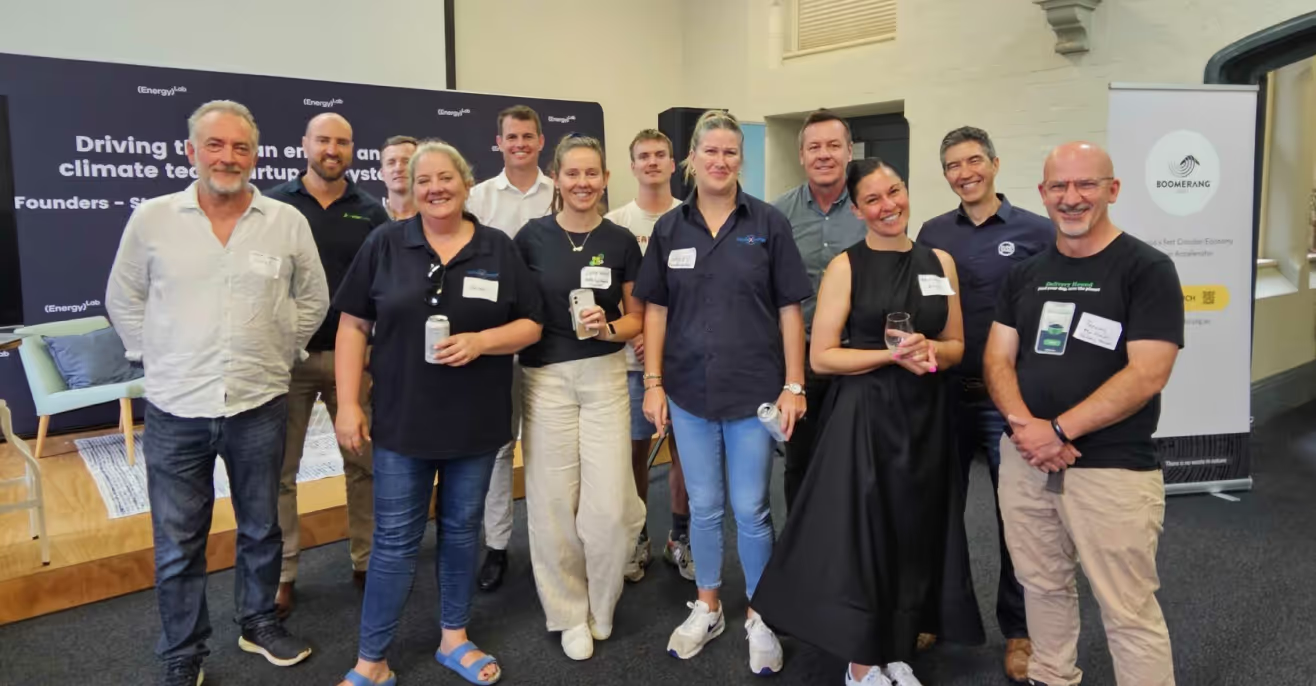
Image: Boomerang Labs 2023-24 Accelerator cohort
Summary
Circular ventures compete with incumbents, need capital for equipment, processes and chemistry, and take longer to return. Piers Grove of Boomerang Labs explains why that makes them look more like small and medium enterprises than the unicorns venture capital is built around, and why leaving the transition to existing companies inside the linear system would simply be too slow.
What this interview covers
Why is it important to fund circular economy innovations?
What are the benefits and risks of funding circular innovations?
What do investors look for when investing in a circular startup?
What are the unique challenges circular economy startups face when trying to secure funding?
How do circular innovation and climate tech intersect?
How can we encourage investment in circular economy startups?
How can the government help build the investment ecosystem?
How do you see the investment landscape for circular economy startups evolving in the near future?
The transition to a circular economy presents both an incredible opportunity and a significant challenge for startups. While the sector is gaining momentum, many entrepreneurs face hurdles in securing the funding necessary to scale their innovations.
In this interview, Piers Grove shared the nuances of funding circular economy startups, uncovering insights into the unique challenges, opportunities and the evolving investment landscape. Piers’ opinions offer insightful understanding how sustainable businesses can thrive with the right financial backing.
They’re more like small-to-medium enterprises than unicorns.
Piers Grove, Co-founder, Boomerang Labs
Why is it important to fund circular economy innovations?
The world is at a point where a push to a circular economy is inevitable. By funding these innovations, we’ll create better products and push the market to take them seriously. It is crucial to lead in the sector and speed up the transition.
But the hard work has to be done to provide the technologies, get the minimum viable products up, and be able to bring on the first customers.
The overriding driver is for change and to make this transition, so getting these companies the capital they need is vital. If we do not fund them, we leave the existing companies to find solutions within the linear system. That will be too slow.
What are the benefits and risks of funding circular innovations?
The real potential is to create impactful and profitable change. It’s appealing for those who want to invest for the future, because the solutions focus on transforming expenses into valuable assets.
However, these companies have to compete with traditional companies. They’re also more capital intensive than tech startups. They’re more like small-to-medium enterprises than unicorns. They need more investments in equipment, processes and chemical innovations. As a result, it takes longer for returns to be made, making them not fit the traditional venture investment mould.
That said, the investment landscape is gradually shifting, with early adopters representing around 3 percent of the market. They’ve shown a strong appetite for circular technologies.
The investment market will figure out where the sweet spots are—what is too early, what is too late, and how to engage. They’ll be ready to deploy their capital in meaningful ways.
What do investors look for when investing in a circular startup?
Despite the differences, we do go back to the absolute fundamentals for early-stage company investment.
A really good technology or idea with a clear market and defendable products.
A strong founding team capable of delivering on the vision.
Competitive landscape. Who else is attempting to solve the problem? What is their traction?
Additionally, investors also consider whether the ecosystem is ready to support innovation. For example, organic waste. If the waste stream can’t support it, even if you have got the world’s best processor, it still goes straight to landfill.
It takes time to build an ecosystem. The traditional five-to-10-year exit timeline is tough for new companies that rely on the ecosystem to come together. We’ve seen this in the energy sector. Eventually, you can reach critical mass, but it can take more than 10 years.
However, circular start-ups’ secret power is their impact. That is what gives them a competitive edge in the market. There is an inevitability to it, and people want to be part of the transition. So you need to demonstrate the impact you can bring to the industries and the world.
What are the unique challenges circular economy startups face when trying to secure funding?
It all comes down to investor appetite, the readiness of innovations for commercialisation and government investment. There can be uncertainty for investors, as to how it’s going to play out. For example, in ReCo’s case, at a large scale, how do you refill the jars efficiently? How do you distribute them? How do you compete on price in that market?
The markets will find a way through. The sector is driven by popular demand and government requirements, and it’s poised for transformation.
As we’ve seen with climate change, acknowledging the need for action isn’t enough. The actions have to follow on the heels of ambition.
How do circular innovation and climate tech intersect?
Many companies have applied for both Boomerang Labs, our circular incubator; and Energy Lab, our climate and energy incubator. Both sectors share similar structural challenges.
Circular innovation is part of a complex machine. The energy sector has untapped potential in terms of circularity. Tackling some of the circular challenges is incredibly exciting. Like Relectrify, a startup in Victoria, has been doing tremendous work in recovering end-of-life batteries. Green hydrogen is also a fabulous product for industrial purposes.
Both sectors have to overcome the price challenge. The best way to get that down is by people adopting and using it. You can get early adopters in, but you have to grow, so it becomes more cost competitive.
The two sectors could drive change together. Collaboration holds great promise in developing climate-friendly solutions that are better for the future.
How can we encourage investment in circular economy startups?
Companies need to get their narrative right and communicate effectively with consumers. If customers aren’t aware of your innovations, it’s challenging to attract investment.
So there’s a big education piece to be done. We see brands like Zero Co, who have managed to connect with their audience, and empower their customers to consume in alignment with their values.
When consumers can relate to your purpose, they become advocates and investors. Crowdfunding is a good example. For instance, Evee, a peer-to-peer electric car-sharing business, completed a $1.4 million crowdfunding raise ahead of schedule.
We know this is not a sit-back situation. It’s a roll-up-your-sleeves and get-the-job-done opportunity. People power will determine how quickly we can achieve this important transition.
How can the government help build the investment ecosystem?
The government plays a vital role in this transition. It’s also one of the biggest beneficiaries. There are huge opportunities like commercialising intellectual property, generating new jobs, and creating a global impact, along with the need to achieve sustainable sovereignty.
They need to foster entrepreneurship. They need to support the founders to do the early work, demonstrate their impact and bring on early customers.
Building the ecosystem is key. The government is responsible for building the basic requirements to create a new industry. All of that boosts investor confidence.
But the question is, at what point can the government get involved? Can they be in partnership with the private sector? It is not a one-stop shop, but rather an orchestration of capital options. The market and the government need to figure that out together.
How do you see the investment landscape for circular economy startups evolving in the near future?
We’re going to see a lot of progress over the next few years. The investment community will figure out the right fit, and funds will start to appear. The quantity of capital available is going to be enormous. This sector is not going anywhere; it is a good business to be in.
The quantum will be there, and it’s only going to prove and couple with the impact aspect of it. I think it’s going to get better; it’s going to start really building up momentum over the next few years.
The other significant source of capital that will flow into the sector is the industry. We’re going to see large companies investing in startups to keep up with the market.
Frequently asked questions
Why do circular startups struggle to raise capital?
They are more capital intensive than tech startups, needing investment in equipment, processes and chemical innovation, and they take longer to return. That profile fits an SME more than a venture-scale unicorn.
What happens if they are not funded?
The transition is left to existing companies working inside the linear system, which Grove argues would be far too slow.
What makes them attractive to investors?
The solutions turn expenses into valuable assets, which appeals to investors looking for impact and profit rather than one at the expense of the other.
What has to happen before the capital arrives?
The hard work of building the technology, getting a minimum viable product running, and landing the first customers.
Who are they competing against?
Traditional companies already operating at scale inside a system whose economics still favour them.
What is Boomerang Labs?
Australia’s circular economy accelerator, which runs bootcamps and accelerator programs and convenes a community of entrepreneurs, mentors, students and professionals.
Written by
Pak Chuen Lee
Editor
Pak Chuen Lee is a digital marketer with a passion for sustainability. Pak (Patrick) holds a master degree of commerce and marketing. He’s committed to making a lasting impact through his expanding expertise in digital media.
Danling Xiao
Editor
Danling Xiao is an award-winning entrepreneur and Strategic Director at ReCo. With over a decade of experience spanning brand strategy, customer insight and content marketing, she helps founders and leadership teams navigate complex, highly regulated markets to make confident, high-stakes decisions.