How to Market a Women’s Health Clinic in Australia
6 strategies for growing a women’s health clinic in Australia, inside AHPRA and TGA rules.

Danling Xiao

Summary
On 1 July 2025 Medicare added dedicated menopause and perimenopause health assessment items, used by more than 71,000 Australian women by February 2026. This article sets out 6 marketing strategies for growing a women’s health clinic in Australia, from closing the trust gap that leaves more than 1 in 3 women feeling dismissed by a GP to building AHPRA and TGA compliance in from day one.
Key takeaways
The global menopause market is forecast to reach US$26.21bn by 2030, growing at 7.1% a year (Menopause Global Market Report 2026, The Business Research Company).
Medicare added dedicated menopause and perimenopause health assessment items — 695 and 19000 — on 1 July 2025; more than 71,000 Australian women had used them by February 2026 (Department of Health, Disability and Ageing).
More than 1 in 3 Australian women report having health concerns dismissed by a GP (ABC, Australia Talks National Survey 2021). The trust gap is the commercial opportunity.
AHPRA prohibits testimonials in advertising a regulated health service, with penalties up to $60,000 per offence for an individual and $120,000 for a body corporate (AHPRA, Advertising and the law).
Market the assessment, the care model and the clinical governance, not the therapeutic good.
Table of contents
Why is the women’s health market growing in Australia?
What is the Longevity Economy?
What has changed in Australian policy?
What are the key marketing strategies for a women’s health clinic?
1. Bridge the trust gap with biological literacy
2. Match your messaging to search intent: symptom vs pathway
3. Answer the conversion questions before the consultation
4. Market to psychographics, not just wealth
5. Reframe anti-ageing as power ageing
6. Navigate AHPRA and TGA compliance for health marketing
Case study: how ReCo built a 90-day lead engine for Sun Health Clinic
The challenge: standing out in a saturated Sydney market
Our approach: audience insight and a messaging overhaul
The result: a 90-day lead generation engine
What should women’s health clinics prioritise in 2026?
Why is the women’s health market growing in Australia?
For decades, the Western longevity industry has been marketed through a masculine lens. Cold plunges. Fasting protocols. Testosterone optimisation. Biohacking dashboards built on male physiology.
Meanwhile, women, who live about 4 years longer than men in Australia, 85.1 years against 81.1 (ABS, 2022–2024) were offered vague “self-care” advice and reactive, symptom-based treatments.
That imbalance is shifting. Demographics, healthcare engagement, and consumer expectations are converging at scale. For wellness clinics, longevity doctors and health practitioners in Australia, the rise of the Women’s Longevity Economy represents one of the most significant strategic opportunities of the decade.
What is the Longevity Economy?
The Longevity Economy is a term used by economists and global institutions to describe the economic and social systems that enable people to live longer, healthier, and financially resilient lives as populations age.
According to the World Economic Forum, the number of people aged over 60 is expected to more than double to 2.1 billion by 2050 — a projection drawn from World Health Organization data.
In Australia, women are leading this shift, and the engagement gap is measurable rather than anecdotal. Women accounted for 58% of all Medicare-subsidised services in 2023–24, and 88% of women had a GP attendance against 80% of men (AIHW). Globally, the World Economic Forum and McKinsey Health Institute size the prize for closing the women’s health gap at US$1 trillion a year by 2040.
Commercially, the global menopause market is forecast to grow from US$19.95 billion in 2026 to US$26.21 billion by 2030, a compound annual growth rate of 7.1% (Menopause Global Market Report 2026, The Business Research Company). Read that as direction rather than precision: it covers therapies and supplements worldwide rather than clinic services, and independent forecasts of the same market differ substantially.
What has changed in Australian policy?
The Australian tailwind is regulatory, not only cultural. The Senate’s inquiry into issues related to menopause and perimenopause reported in September 2024 with 25 recommendations, concluding that gaps in clinician education were materially affecting women’s care. In February 2025 the Government responded with a $573.3 million women’s health package, including the first PBS listings for new menopausal hormone therapies in more than 20 years.
The change that matters most to clinics: from 1 July 2025, Medicare added dedicated menopause and perimenopause health assessment items, 695 and 19000. More than 71,000 women had used them by February 2026 (Department of Health, Disability and Ageing). A funded, named assessment now exists as a recognised entry point — which is precisely the kind of tangible first step the rest of this article argues for.
To capture this shifting market and build a brand that resonates with the modern midlife consumer, here are the 6 key marketing strategies your clinic needs to master in 2026:
What are the key marketing strategies for a women’s health clinic?
These 6 strategies separate high-growth women’s health clinics from the rest: building trust through biological literacy, matching messaging to search intent, answering the conversion questions upfront, targeting psychographics rather than wealth, reframing anti-ageing as power ageing, and staying compliant with AHPRA and TGA rules.
1. Bridge the trust gap with biological literacy
The current landscape is defined by fragmented, exaggerated and often distrusted information.
In Australia, the ABC reported that more than 1 in 3 women felt their health concerns had been dismissed by a GP, drawing on the Australia Talks National Survey of 60,000 people. That was 2021, and the pattern has held: the AIHW still finds women more likely than men to report being sometimes, rarely or never listened to by a GP or specialist.
The knowledge gap is just as wide. In a survey of 1,596 women published in Post Reproductive Health, only 21.9% felt well informed about the menopause transition. Combined with a flood of misinformation from social media influencers, it is creating a significant trust gap.
Forward-thinking Australian health clinics can step into this gap by providing:
Biological literacy: Explaining the why behind hormonal and physiological shifts.
Genuine care: Validating the lived experience of perimenopause and beyond.
Clear pathways: Moving the patient from “What is wrong with me?” to “What do I do next?”
2. Match your messaging to search intent: symptom vs pathway
Positioning your clinic requires a deep understanding of user intent. You may offer the best clinical care in Australia, but without the right language, it is hard to cut through a crowded market.
Matching Language to Intent:
Symptom-Led (High Urgency): For users searching for immediate relief, simplicity converts. Use terms like “menopause support” or “evidence-based hot flush treatment.”
Pathway-Led (Premium/Longitudinal): For long-term health, framing increases perceived value. Use terms like “Hormonal & Metabolic Reset,” “Longevity Program,” or “Women’s Vitality Plan.”
3. Answer the conversion questions before the consultation
In 2026, clarity is the ultimate conversion lever. When a patient is time-poor or frustrated, your marketing must answer:
What is included in the assessment?
What tests and biomarkers do you measure? (e.g., DEXA bone density imaging, inflammatory markers, hormonal profiling)
How long does the initial phase take?
How much does it cost?
By offering tangible entry points, like a “Menopause Medical Assessment” or “Metabolic and Hormonal Profiling”, you reduce uncertainty and provide the safety and realistic expectations this audience demands. On cost, be specific about what Medicare does and does not cover: since 1 July 2025 the menopause and perimenopause health assessment items have given eligible patients a rebated starting point, and clinics that state the gap payment plainly convert better than those that leave it unsaid.
4. Market to psychographics, not just wealth
It is tempting to frame this audience as exclusively affluent, but that is strategically reductive. The real commercial opportunity lies in psychographics. This audience values:
Evidence over trends
Structured plans over vague advice
Expertise over influencer culture
Time efficiency and long-term outcomes
In our client work, clinics that articulate a clear pathway consistently outperform brands selling generic wellness services with vague promises.
5. Reframe anti-ageing as power ageing
Language shapes perception. Traditionally, “anti-ageing” implies decline, fear, and concealment. The brands winning the Australian market in 2026 are reframing midlife as “power ageing.” It is about strength, agency, capability and empowerment.
However, your claims must be substantiated. The phrase “menopause gold rush” comes from researchers at UCL’s Institute for Women’s Health, who warned that a rapid proliferation of unevidenced information and unregulated products leaves women exposed to financial exploitation; The Guardian carried it into the mainstream in February 2026. Clinics must avoid the hype and focus on transparent, evidence-based communication.
6. Navigate AHPRA and TGA compliance for health marketing
In Australia, clinic marketing must align strictly with regulatory frameworks. Two apply at once, and they are not the same thing. AHPRA regulates how you advertise a regulated health service; the TGA regulates the advertising of therapeutic goods. Most women’s health clinic marketing sits in the overlap, so both bite.
The stakes have risen. Section 133 of the National Law bans testimonials about a regulated health service — on your own site and on social media alike — and since the 2022 amendments the maximum penalty is $60,000 per offence for an individual and $120,000 for a body corporate. From 2 September 2025, AHPRA’s guidelines for advertising higher-risk non-surgical cosmetic procedures added another layer for any clinic offering them.
Rather than marketing a specific medicine or a “cure,” successful Australian clinics focus their brand on:
The assessment: Comprehensive diagnostic protocols.
Care model: Multidisciplinary support.
Clinical governance: Safety and practitioner expertise.
By marketing the system of care rather than the therapeutic good, you build a brand that is both compliant and authoritative.
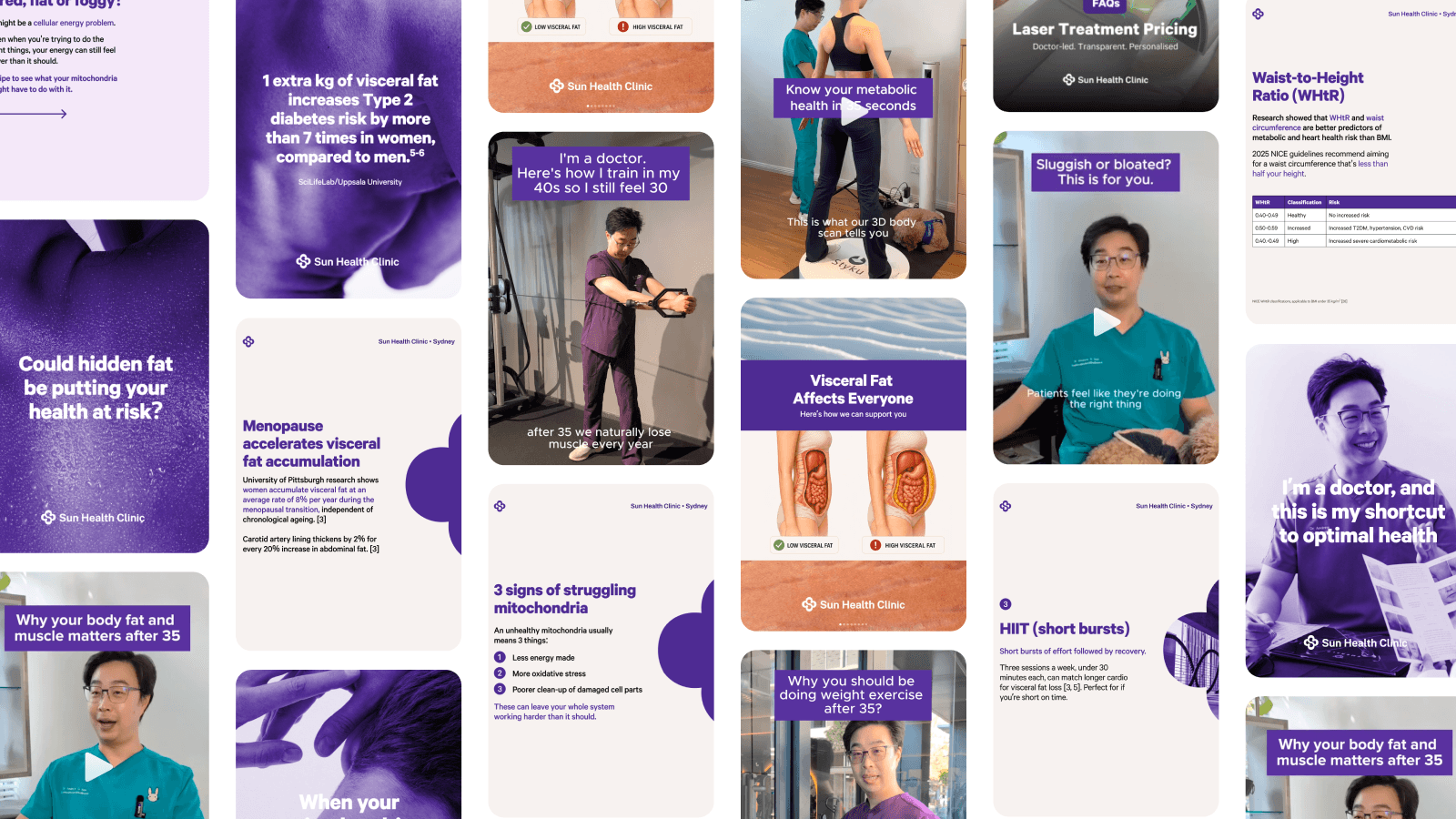
Image: Sun Health Clinic
Case study: how ReCo built a 90-day lead engine for Sun Health Clinic
The challenge: standing out in a saturated Sydney market
When Sun Health Clinic in Sydney partnered with ReCo, the immediate hurdle was brand positioning. In a saturated Sydney market, they needed to move beyond being “just another clinic” and clarify exactly how they served their patients while staying inside strict AHPRA advertising rules.
Our approach: audience insight and a messaging overhaul
Audience insight: We began with deep research into the patient base, identifying that the vast majority of their high-value clients were women navigating the complexities of perimenopause and menopause.
Messaging overhaul: We moved away from generic “wellness” clichés. Instead of a cold, purely clinical tone, we reframed the patient journey with clarity and care. By targeting specific symptoms as a “cut-through” strategy, we made the clinic’s expertise feel accessible and empathetic rather than intimidating.
Compliance-first collaboration: Working directly with the Sun Health medical team, we audited and refined all digital assets to ensure they met TGA guidelines without losing their marketing “punch.”
The result: a 90-day lead generation engine
Through rapid experimentation and data-driven testing, we built a robust lead generation system in just 90 days. By identifying exactly what messaging resonated with the target audience, we successfully bridged the gap between online interest and qualified doctor consultations.
Learn more from our case study.
What should women’s health clinics prioritise in 2026?
To succeed in the Women’s Longevity Economy, Australian clinics must move beyond scattered services and toward structured health journeys:
Focus on psychographics: Target women who value evidence, efficiency, and long-term outcomes.
Lead with authority: Replace “spa aesthetics” with clinical excellence and female strength.
Operationalise compliance: Build systems that align with AHPRA/TGA from day one.
Scale with systems: Move from “appointment booking” to “longitudinal care management.”
Partner with ReCo for your clinic’s growth
The Women’s Longevity Economy is here. If you are building a health or wellness brand in Australia and want to position it strategically, our Sydney-based team specialises in building sustainable, compliant growth systems for ambitious founders.
Frequently asked questions
What is the Women’s Longevity Economy?
The Women’s Longevity Economy is the market for products, services and care models built around women living longer, healthier lives. It spans perimenopause and menopause care, metabolic and hormonal health, bone density and cognitive resilience, a shift from reactive symptom management toward proactive healthspan investment, driven mainly by women aged 45 to 60.
How do you market a women’s health clinic in Australia?
Australian women’s health clinics grow by marketing a system of care rather than a treatment. Lead with a named assessment offer, explain the biology behind symptoms, publish which biomarkers you measure and what the initial phase costs, and target women who value evidence and structured plans over those who simply have money.
Can an Australian health clinic use patient testimonials in its marketing?
No. AHPRA’s advertising guidelines prohibit using testimonials or purported testimonials about a regulated health service or business. The rule covers reviews you solicit, comments on channels you control, influencer content you commission and patient quotes on your own site. Penalties reach $60,000 per offence for an individual and $120,000 for a body corporate.
Does the TGA regulate health clinic advertising?
The TGA does not regulate the promotion of health services — it regulates therapeutic goods. However, the Therapeutic Goods Act applies the moment your advertising also refers to a therapeutic good, such as menopausal hormone therapy or a compounded hormone. Most women’s health clinic marketing sits in that overlap, so both frameworks apply in practice.
What is the biggest mistake clinics make when targeting midlife women?
The biggest mistake is meno-washing: attaching wellness language to an offer without naming what is actually measured or delivered. UK research from UCL has flagged a “menopause gold rush” of unregulated products, and this audience is now sceptical by default. Vague promises lose to a clinic that publishes its diagnostic process.
Should a clinic use “anti-ageing” or “power ageing” in its messaging?
Use power ageing. Anti-ageing frames midlife as decline and concealment, which alienates the audience that actually spends. Power ageing, or healthspan optimisation, frames it as strength, agency and capability, and attracts higher-intent patients seeking a long-term health partner rather than a quick fix. Every claim still needs substantiation.
What tests and biomarkers should a women’s health assessment measure?
Published Australian clinic examples include DEXA bone density imaging, inflammatory markers and full hormonal profiling. Naming exactly what you measure is one of the strongest conversion levers available, because it turns an abstract wellness offer into a tangible clinical process a patient can evaluate before booking.
What do patients need to know before booking a consultation?
Four things: what is included in the assessment, which biomarkers you measure, how long the initial phase takes, and how much it costs. Publishing these answers removes the friction that stops time-poor patients from booking, and it is the clearest signal that a clinic runs a defined pathway rather than an open-ended service.
How big is the menopause market in 2026?
The global menopause market is forecast to grow from about US$19.95bn in 2026 to US$26.21bn by 2030, a compound annual growth rate of roughly 7.1%. In Australia, demand is reinforced by Medicare menopause and perimenopause health assessment items introduced on 1 July 2025, used by more than 71,000 women by February 2026.
Relevant links
Author
Danling Xiao
Founder & Strategic Director, ReCo
Danling Xiao is an award-winning entrepreneur and Strategic Director at ReCo. With over a decade of experience spanning brand strategy, customer insight and content marketing, she helps founders and leadership teams navigate complex, highly regulated markets to make confident, high-stakes decisions.