

4 weeks
From concept to working MVP
Near 100% Accuracy
Reading receipts automatically
1 Full Picture
Of food input and waste, for the first time
About Radish Events
Radish Events is a Sydney caterer built around doing food properly: boldly delicious and sourced and served with an ethical approach from the start.
For years, the team had been manually weighing every bit of compost and waste to keep as much as possible out of landfill. That told them what they were throwing away. What it couldn't tell them was how much food they were actually bringing in, since that information only existed as stacks of receipts from dozens of different suppliers.
Without that input data, Radish had no real way to measure how efficient they actually were, or how much impact their waste reduction work was having.
The brief: turning receipts into real data
Assess what was technically feasible and recommend the right tech stack
Map out an implementation timeline and the security requirements around it
Design a tailored AI solution built around how Radish actually operates
Give the team instant data capture, analysis and visualisation, not another manual process
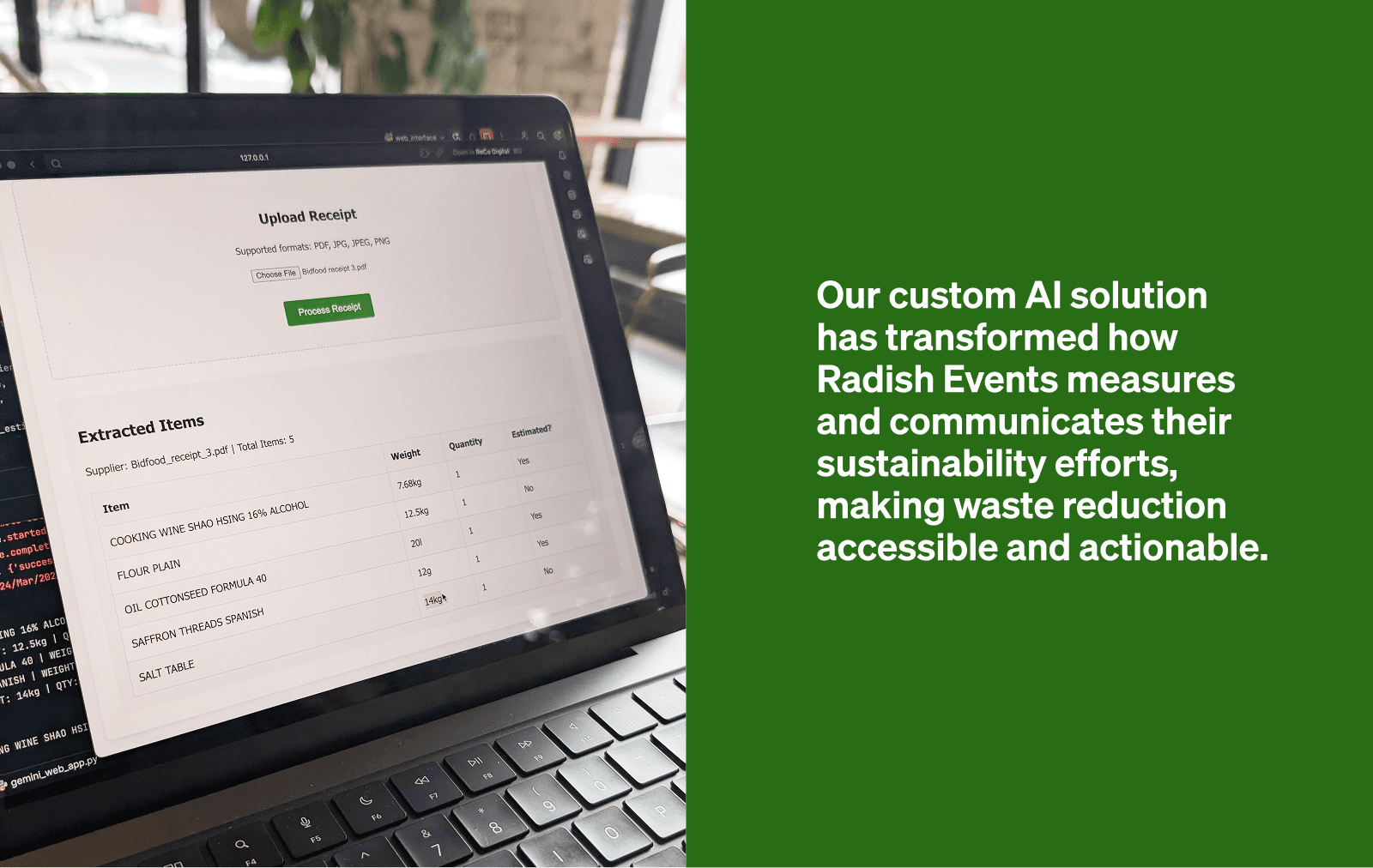
01 Understanding the real problem
We worked closely with Henri Turra, managing director of Radish Events, to dig into what was actually going on. Measuring waste output was already straightforward. Measuring input was the missing half of the equation, and without it, Radish couldn’t calculate a genuine waste reduction rate or prove their real environmental impact.
That discovery process is what shaped the brief. We needed something that solved the actual problem, not just a technically impressive tool that didn’t fit how the team worked day to day.
02 Testing the right AI approach
Before writing a line of code, we tested a range of AI and image recognition options, from purpose-built image recognition tools to APIs like Azure Computer Vision, alongside more general AI models.
Each one was tested for accuracy, how realistic it would be to implement, and how easy it would actually be for a busy catering team to use day to day. That comparison is what let us land on an approach that balanced real capability with something Radish could actually run on a Tuesday morning.
03 Building the backend
Once we’d settled on the most accurate approach from our testing, we built the backend system in 4 weeks. The integration reads weights straight off supplier receipts and automatically sorts different food items into categories, with accuracy close to 100%.
Security was built in from the start, not added afterwards. We applied modern data protection practices to keep Radish’s business information safe as it moved through the system and into storage.
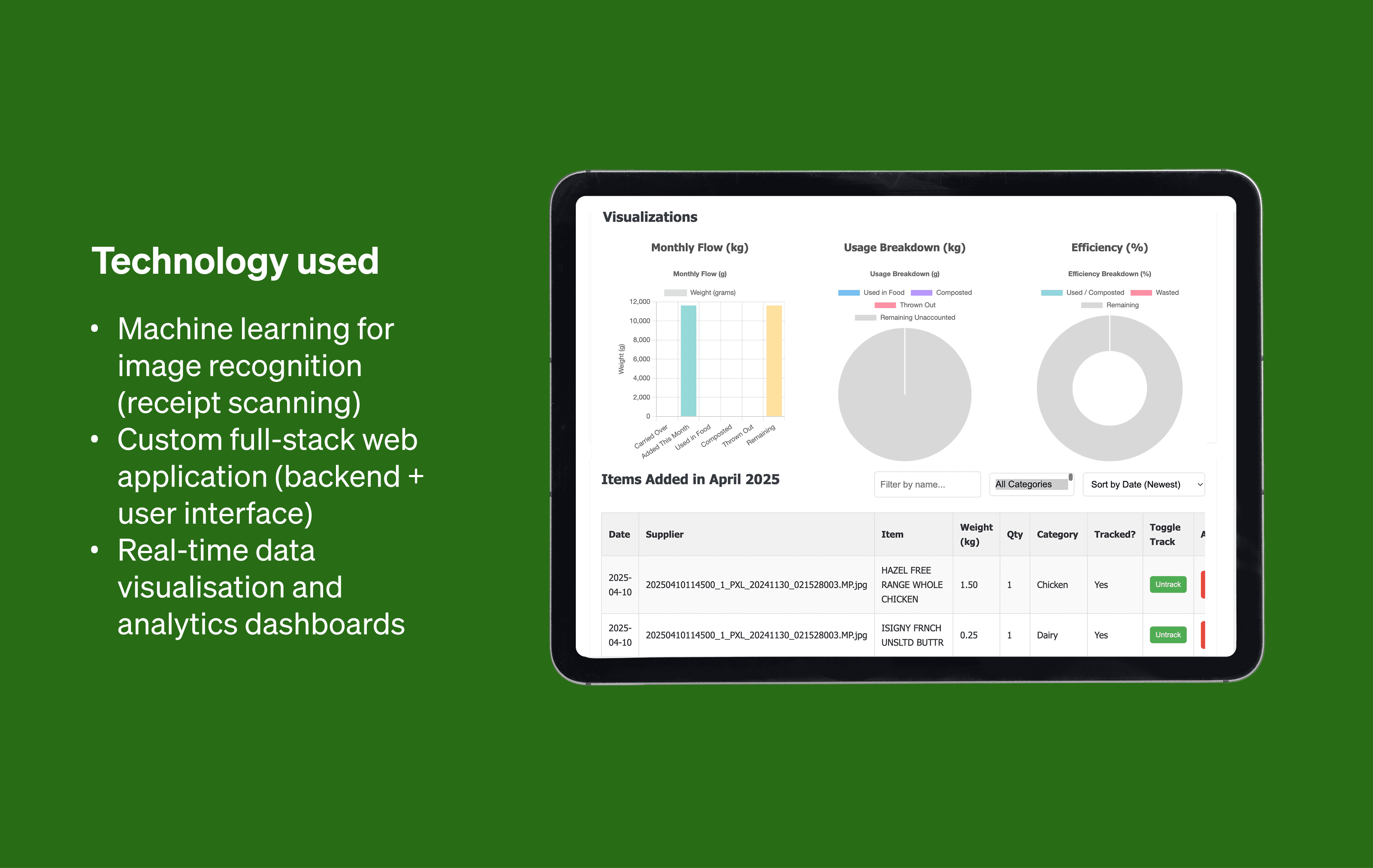
04 Designing the interface
A powerful backend means nothing if nobody wants to open the app. So we built a simple, modern frontend that lets the Radish team:
Upload and process receipt images without any fuss
Step in and correct the AI when it gets something wrong
See their food usage patterns laid out in custom dashboards
Spot where they could cut costs or reduce waste further
The whole thing was designed to need almost no training, while still giving the team genuinely useful analysis underneath.
05 Refining it with feedback
We handed the MVP to Radish and then kept iterating based on what they actually told us. We tailored the analysis tools and dashboards to match how they wanted to report on their own operations, so the interface fit their daily routine instead of asking them to change how they worked.
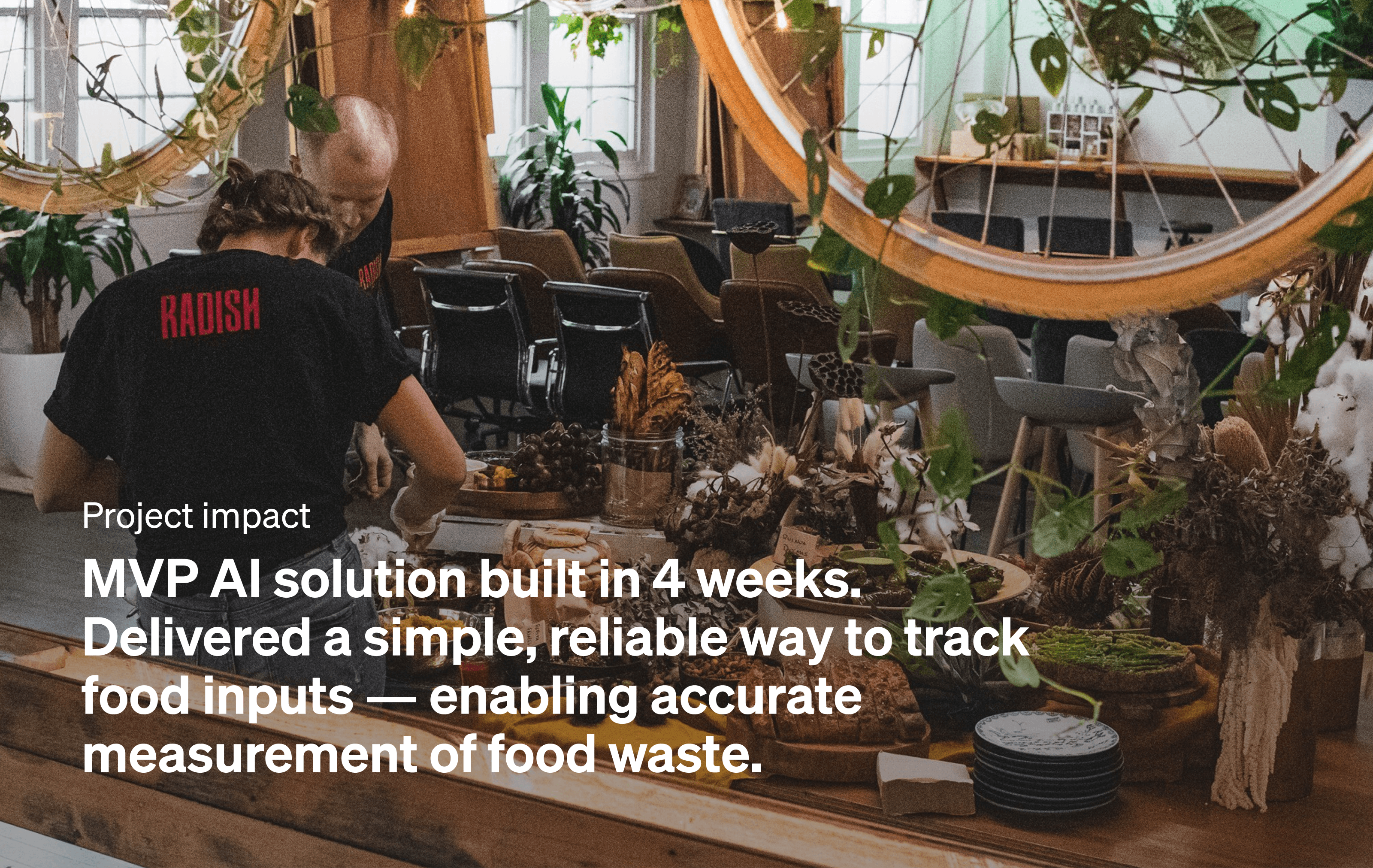
Project impact
Delivered a working MVP AI solution in just 4 weeks
Gave Radish a simple, reliable way to track food inputs for the first time
Enabled accurate measurement of food waste and the CO2 emissions it creates
Replaced a manual, receipt-based process with instant data capture and analysis
Key takeaways for AI innovation
The right strategy makes speed possible: a custom AI solution can go from concept to tested, working product in just a few weeks, when the groundwork is done properly first.
Good AI tools fit into existing workflows, not the other way round: the strongest integrations strengthen how a team already works instead of asking them to change everything.
Accurate data builds real credibility: once Radish could see the full picture of food in and food out, they could talk about their sustainability impact with actual confidence, not estimates.
Test before you build: comparing multiple AI approaches upfront meant we backed the right technology instead of guessing.
AI innovation for sustainability: FAQs
How do you measure food waste when you don’t know how much food came in?
You can’t, not accurately. Radish had years of solid data on what they threw away, since that was measured by hand. What was missing was the input side: how much fresh produce actually arrived from their suppliers. That gap meant they could see part of the story but not the full picture, which is exactly the problem this project was built to solve.
Why build a custom AI tool instead of using an off-the-shelf app?
Because most existing tools weren’t built around how a catering business actually receives food, which is scattered receipts from many different suppliers, in different formats, with different layouts. We tested several existing AI and image recognition options before deciding a tailored solution built around Radish’s real supplier data would get closer to genuine accuracy than a generic tool ever could.
How did you get an AI tool to read receipts accurately?
Through testing, not guesswork. We compared purpose-built image recognition tools, APIs like Azure Computer Vision, and broader AI models, checking each one for accuracy and how realistic it would be to actually implement. The approach we landed on reads weights and categorises food items from receipts with accuracy close to 100%.
How do you get a small team to actually use a new piece of software?
You make it require almost no learning curve. The frontend was designed so the Radish team could upload receipts, review and correct the AI’s readings, and see their data visualised, without needing training. We also built in feedback loops after the first version launched, refining the dashboards to match how the team actually wanted to report on their operations.
What does accurate waste data actually let a business do?
It lets them prove their impact instead of estimating it. Once Radish had a full picture of food input against food waste, they could measure their genuine waste reduction rate and the CO2 emissions tied to it and back up their sustainability claims with real numbers rather than approximations.
Services
Discovery and strategy
Stakeholder interviews · Technical feasibility assessment · Implementation timeline and security planning
AI and systems development
AI model evaluation and testing · Receipt image recognition and data extraction · Custom backend development · Data security implementation
Product and interface design
Frontend design and development · Dashboard and data visualisation · Usability testing with the Radish team
Iteration and support
Post-launch feedback loops · Dashboard refinement · Ongoing product iteration
Credits
Project director: Danling Xiao
AI development: Ellen Zheng and Zhakhangir Mamayev
Photos: Radish Events / Andrea Veltom


