Nick Gonios on Product Usage over Ownership
An interview with Nick Gonios, Founder and CEO of Circulist
This article is part of Circular Sydney, ReCo’s initiative to empower sustainable businesses, supported by the City of Sydney Knowledge Exchange grant. See how it came to life in our case study.

, Circulist
Written by
, Lina Wood
, Danling Xiao
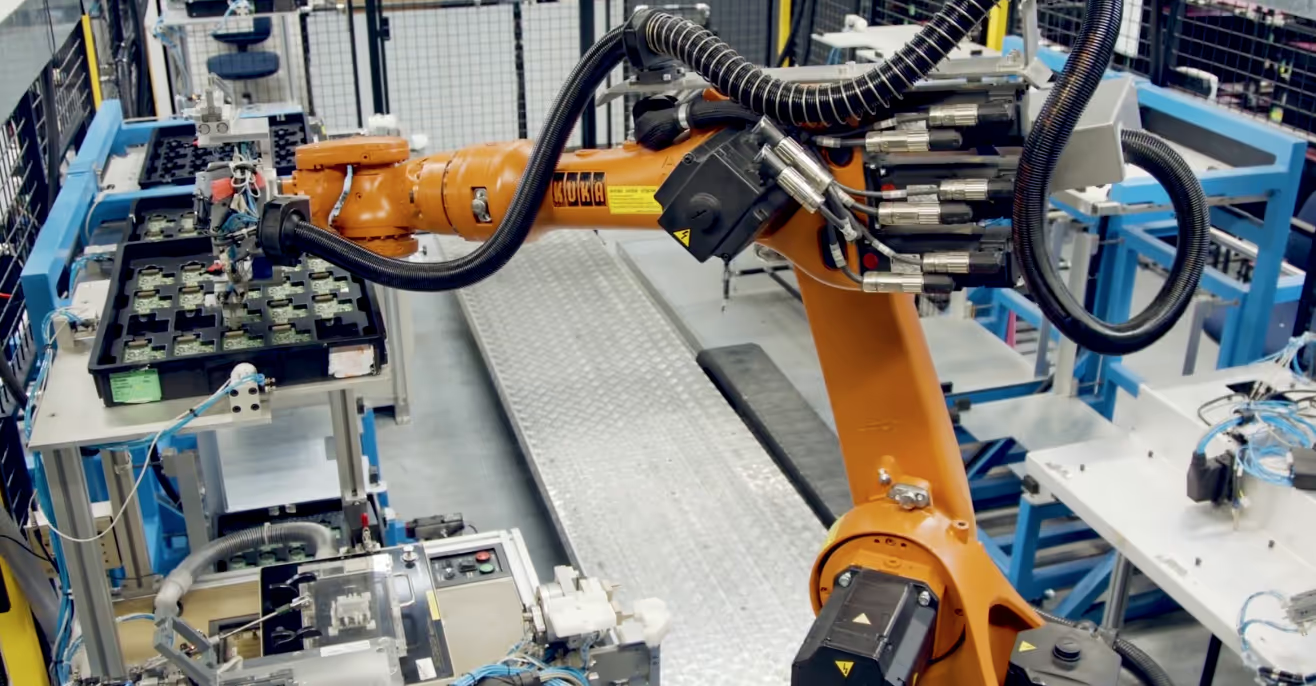
Image: Circulist
Summary
We are consuming and wasting resources at a rate exceeding the Earth’s capacity by 75%, and the economic system is built to keep doing it. Nick Gonios, founder and CEO of Circulist, argues for shifting from ownership to product usage, drawing on what software-as-a-service did to CDs and DVDs, and for bringing production back to decentralised local scale.
What this interview covers
What challenges are we facing? how can we solve them?
How does the product-usage model work?
How can we transition to a product-usage model?
What innovative projects in Sydney are changing the way products are used?
How challenging is it to get funding?
How can technology accelerate us toward circularity?
What’s your vision for Circulist?
In this interview, we talk to Nick Gonios about how to transform manufacturing, its challenges and the role of technology in a greener future.
We’re over-consuming a lot of resources from Earth, and wasting them at a rate exceeding its capacity by 75%.
Nick Gonios, Founder and CEO, Circulist
What challenges are we facing? How can we solve them?
We’re over-consuming a lot of resources from Earth, and wasting them at a rate exceeding its capacity by 75%. This issue is backed by the whole economic system. We’ve shifted heavily towards building bigger factories, producing more products and shipping them around the world—without consideration of the environmental impact.
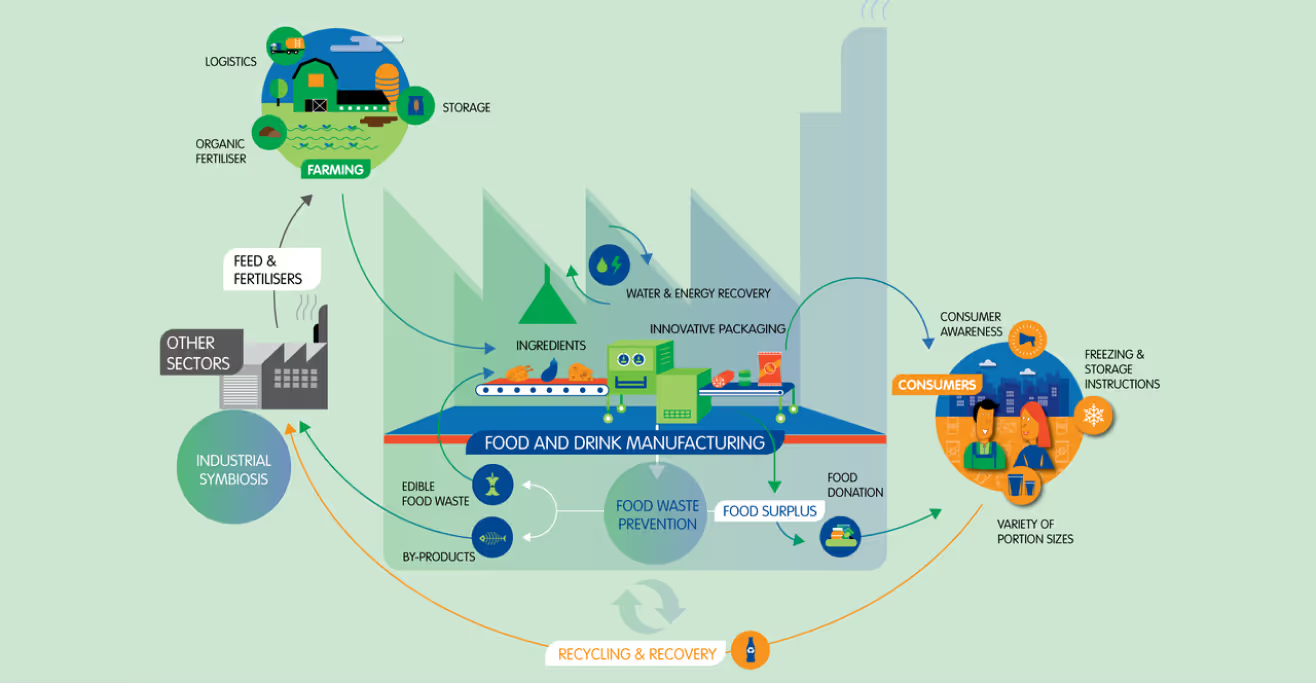
We need to shift away from consumption to a model that prioritises product usage over ownership. By doing that, we can move away from extracting virgin materials, and start using resources we already have.
It also means bringing production services back to a local scale, in decentralised systems that value people, local communities and the planet.
Coming from the tech sector, I’ve witnessed how we’ve shifted away from the ownership model over more than a decade. Software-as-a-service has removed the need for physical products like CDs and DVDs. We now are at the cusp of doing everything as a service to reduce our reliance on virgin resources.
How does the product-usage model work?
Further to your interview with Nila Rezaei about the product-usage model, it involves several elements. First, products are designed to last. They’re easy to repair and recyclable. Instead of purchasing a product upfront, people either subscribe to it or pay only when they use it. Often, multiple people share the same item.
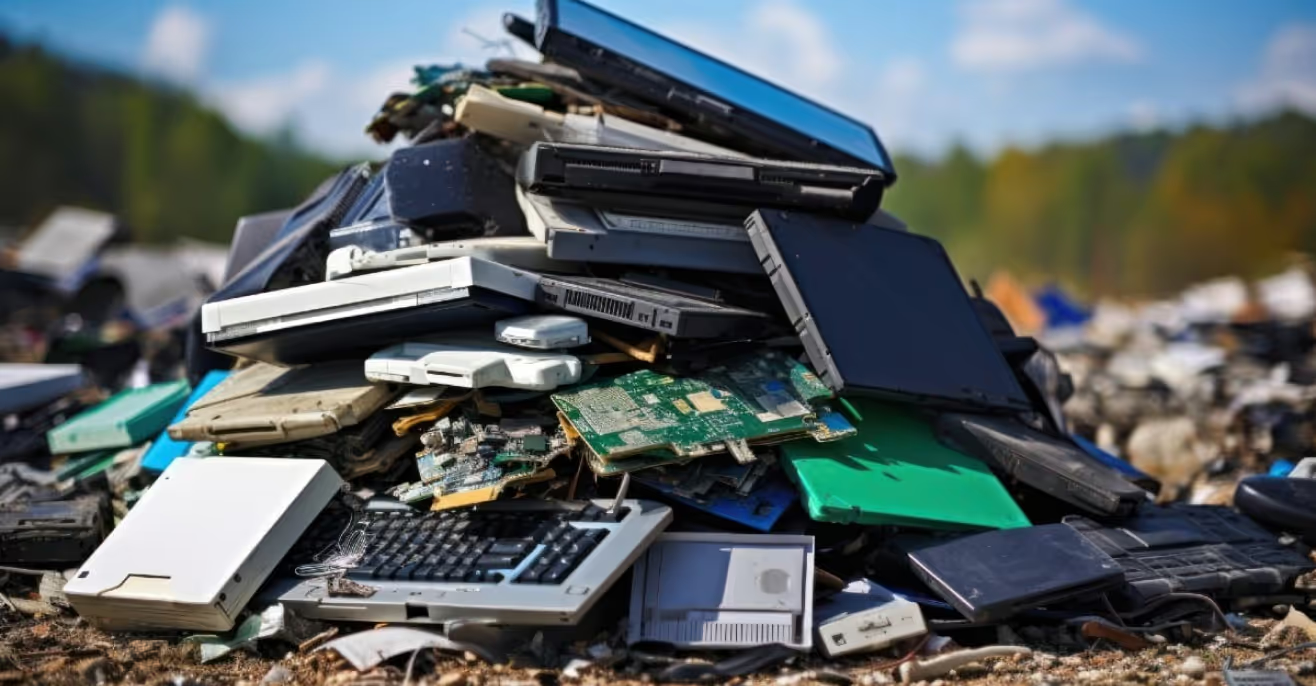
Responsibility for the product is shared between users and the company. The company handles maintenance, repairs, and recycling. In Sydney, GoGet and Zoomo are great examples. This concept of the sharing economy moves us away from the idea of owning everything. Still, challenges remain, especially with complex items like electronic waste. For instance, recycling smartphones is tricky due to their mixed materials and complicated disassembly processes.
Two smartphone companies are moving towards this model. Fairphone in the Netherlands focuses on creating smartphones that users can update and repair themselves. Different parts like the camera, battery, and processing power can be swapped out for better versions.
Apple is working towards a long-term circular approach, shifting towards the as-a-service offering. They are the masters of taking us onto a behaviour change over time. We’ve been able to trade in a phone or subscribe to Apple Care. Furthermore, they’ve developed disassembly robots named Daisy and Daisy 2, which are instrumental in breaking down iPhones. This progressive approach is leading to the creation of an iPhone-as-a-service offering under a subscription framework.
How can we transition to a product-usage model?
The product-usage model is coupled with innovation in design and manufacturing. At Circulist, we propose to bring production services back to our local cities again. We can build a network of micro-assembly service centres, and use smart robotics technologies to service and remake products — in local, close-loop environments.
How do we get there? I learned to be very entrepreneurial in tech. You have to have a vision for the future, go after it, and work with teams and organisations to make it happen. With the circular economy, we have to have a vision for the real world, not just the digital one. That’s more difficult.
We’re talking about changes in every aspect, at every level. These are long term changes. It’s probably going to take two to three generations to fully transition out of the industrial framework into a regenerative local economy.
But where do we begin? We need to start somewhere, which is why Circulist was founded. Our aim is to facilitate this transition by supporting product brand manufacturers move away from large-scale factories. Instead, we advocate for micro-assembly service centres in cities worldwide. By doing that, we can catalyse a shift in mindset and foster the momentum needed for a more sustainable future.
What innovative projects in Sydney are changing the way products are used?
There are some exciting projects Circulist is involved with right now. One of them is BVN’s Systems Reef 2 (SR2) by BVN. It’s the world’s first reimagined air ventilation system. Moving away from the old metal ducted systems, SR2 uses recycled plastic from hospitals to 3D-print custom air systems for offices. I’m glad that you’ve talked to Ninotschka Titchkosky (BVN) about it.
Another one is Hullbot, a startup making robots that clean boat hulls to keep oceans healthy. The robots are delivered to the users as a service.
Both BVN and Hullbot are from Sydney and are aiming to grow worldwide. We’re working closely with them.
These ideas are great, but they need to grow fast. We have smart people, but we also need funding, government support and better infrastructure to create a bigger impact.
How challenging is it to get funding?
Transitioning companies into a circular economy requires a lot of capital. We’re talking about trillions of dollars worldwide to reshape our economy into one that’s circular.
There are financial sources, like the green bonds and sustainable bonds. Some big banks are already doing this globally. But there’s a problem: only big brands can really use these money tools. We need them to work for smaller groups too. Right now, this is something the banking system doesn’t do well.
We can make changes in how money works to make this possible. In Australia, our banking system is good but mostly focuses on property. It doesn’t value production and enterprising nature.
I strongly believe Australia could create a growth capital fund to help companies go circular. This fund could work with the Sustainable Development Goals to support good changes.
Another important part is the government. Right now, they mostly think about rules. We need them to team up with businesses, universities and communities to reshape the ecosystem. Then we could scale a lot faster.
How can technology accelerate us toward circularity?
Usage intelligence is critical because it’ll help us understand how we use things. Imagine if our devices could track and measure how we use materials in real time. This would help us learn and make future products using fewer resources.
We’ve seen this in the software industry. With everything in the cloud, we’re learning a lot about how people use digital products. We then use those data and insights to inform decision making.
A real example is Rolls Royce’s jet engines. They don’t actually sell jet engines to airlines. They sell fuel-efficiency-as-a service through their jet engines. They’ve been doing it for two or three decades. They help airlines improve fuel efficiency, by designing and producing better jet engines, but also by collecting smart data in real-time. This helps them make the next engines using less materials, energy and water.
In the circular economy, we talk a lot about design. With usage data, we can empower designers to make better decisions in the design phase. Imagine if we could rate how circular a design is, and figure out ways to improve its circularity.
It’s a great opportunity. We’re building it into the Circulist system to help more people make things that are better for our world.
What’s your vision for Circulist?
Circulist’s mission is based on three trajectories:
Partner with mission-driven product brands to shift to micro-assembly service centres. So we can design, build, produce, reuse and recycle products, city by city around the world.
Build a large growth capital fund to help brands make the change.
Build open technologies to provide trust and transparency.
These are the main things we’re doing, but it’s not going to work for everyone right now. We’re starting by partnering with 100 product brands from around the world. We can’t do it all yet, but we’re taking the first steps. We need to first partner with the right brands and players to validate positive traction and deliver value to consumers and businesses.
Rather than chasing huge goals, like the ‘moonshot’, we’re focusing on what’s smart for the environment. At Circulist, we’ve got ‘green shots’ for most things and ‘blue shots’ for things related to the ocean.
We’re at the beginning. Recognising that, I see success with Circulist and the circular economy beyond my lifetime, but I’m committed to building the foundations for a circular future.
Frequently asked questions
How fast are we consuming resources?
At a rate exceeding the Earth’s capacity by 75%, driven by an economic system built around bigger factories, more products and global shipping without regard for environmental impact.
What is the product-usage model?
Products designed to last, easy to repair and recyclable, accessed by subscription or pay-per-use rather than bought outright, often shared between multiple people.
Who is responsible for the product?
Responsibility is shared between users and the company, with the company handling maintenance, repairs and recycling rather than passing that to the buyer.
Are there working examples in Sydney?
GoGet and Zoomo are both cited as sharing-economy models that move away from owning a vehicle outright.
What does software have to do with it?
Gonios came from tech, where software-as-a-service removed the need for physical CDs and DVDs over a decade. He argues everything-as-a-service can do the same for virgin resource use.
Why local production?
Bringing production services back to decentralised local scale values people, local communities and the planet, and reduces the shipping that global manufacturing depends on.
Relevant links
Written by
Lina Wood
Editor
Lina Wood is a science communicator and writer, graduated from a master degree of science communication at The Australian National University.
Danling Xiao
Editor
Danling Xiao is an award-winning entrepreneur and Strategic Director at ReCo. With over a decade of experience spanning brand strategy, customer insight and content marketing, she helps founders and leadership teams navigate complex, highly regulated markets to make confident, high-stakes decisions.